Saudi Arabia recorded 14.6 billion electronic transactions across its national payment systems in 2025. Electronic payments represented 85% of total retail payments. This scale creates a major opportunity to modernize governance, risk and compliance.
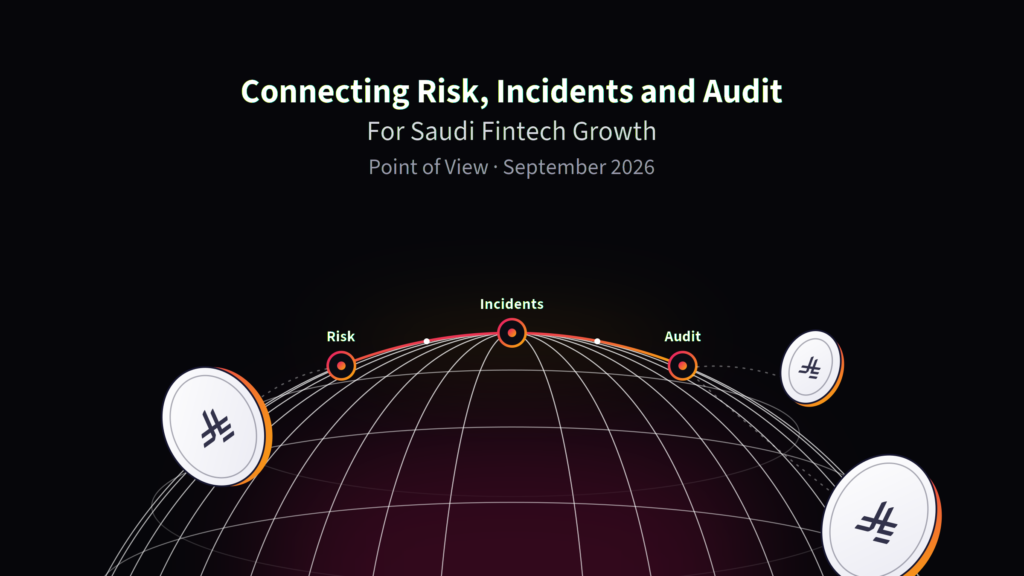
At digital speed, enterprise risks, incidents, corrective actions and audit evidence cannot remain disconnected. At digital speed, enterprise risks, incidents, corrective actions and audit evidence cannot remain disconnected. TransVare One connects ERMVare One, InciVare One and AuditVare One through one shared core.
– ERMVare One connects risks and controls.
– InciVare One captures incidents, root causes and corrective actions.
– AuditVare One delivers independent assurance.
Together, they turn operational activity into traceable evidence, timely assurance and clearer board-level insight.
Our latest POV explores how Saudi fintechs can connect these functions through one shared core.
– Risk identifies the exposure.
– Incident management captures the event.
– Corrective actions address the failure.
– Internal audit provides independent assurance.
One connected view. One accountable workflow. Stronger board-ready evidence.
How Saudi fintechs can connect risk incidents and audit on one shared core
Fintechs operating in KSA span diverse business models. These include supply-chain finance, peer-to-peer lending, digital financial circles and time-deposit aggregation. Each model creates different credit, liquidity, conduct, cybersecurity, data and third-party risks.
This scale requires connected governance and stronger oversight. Separate risk registers, incident logs, corrective actions and audit records can create serious control gaps. One shared core connects enterprise risks with actual incidents. It links control failures with corrective actions. It also gives internal audit traceable evidence for independent assurance and board reporting.
The Operating Gap
Saudi fintechs may be small in headcount, but supervisory expectations follow the licence, activity, customer data and operational importance of the service. Evidence must remain current, connected and available for review.
The Three Questions Every Evidence Model Must Answer
What Could Go Wrong
Current risks, appetite, controls, indicators and accountable owners
What Went Wrong
Incident classification, escalation, notification, root cause and corrective action
Who Checked
Risk-based assurance, test evidence, findings and action closure
The operating implication A lean control team can answer all three questions only when the underlying records connect. Separate spreadsheets create reconciliation work precisely when the regulator or board expects a single, current account.
One Core with Three Functional Owners
The model is federated. Each function keeps its own workflow, accountability and professional independence. Common identifiers connect risks, controls, incidents, tests, findings and actions across the three products.
| Product | Functional Ownership | Board and Supervisory Evidence |
|---|---|---|
| ERMVare One | Risk register, appetite, controls, indicators, treatments and owners | Current exposure, control ownership and action status reported against appetite |
| InciVare One | Incident intake, triage, materiality, investigation, root cause and corrective action | Events classified, escalated, notified and closed with a traceable record |
| AuditVare One | Risk-based planning, fieldwork, control testing, findings and follow-up | Independent assurance linked to the same risks and controls, with evidence of closure |
The Connected Evidence Loop
One record with three owners The risk register provides the baseline. Incidents change the current picture. Audit tests whether the control environment works. Leadership receives one traceable account without removing functional independence.
Adoption That Follows Licence Maturity
The sequence should follow the evidence pressure facing the business. Each stage extends the same taxonomy and evidence structure, so the next product is an addition rather than a rebuild.
Local Cloud Delivery
TransVare One + HUAWEI CLOUD
Live on HUAWEI Cloud in Saudi Arabia
TransVare states that all three products are available as SaaS on HUAWEI Cloud in the Kingdom. This supports a local-cloud deployment option. Each customer must still confirm data classification, residency, outsourcing, cybersecurity and contractual requirements for its licence and use case.
Why the Timing Matters
Category Diversity
Supply chain finance, peer-to-peer lending, digital financial circles and time deposit aggregation create materially different risk profiles. Controls should follow the activity, not a generic fintech label.
Evidence Pressure
SAMA, CMA, SDAIA and NCA requirements create distinct but connected evidence needs. Manual reconciliation weakens as products, customers and third parties grow.
Practical Deployment
A shared SaaS core can reduce implementation and administration burden compared with three disconnected enterprise systems. Timing and cost depend on scope.
What This Changes for Leadership
Founder or Chief Risk Officer
A current view of exposure, appetite, controls and action ownership.
Compliance Leader
Obligations, incident escalation and evidence in one traceable record.
Head of Internal Audit
A risk-based plan, connected evidence and visible finding closure.
Start with the discipline under the most pressure
Establish the shared risk and control taxonomy once. Add the next function as the licence, operating scale and assurance needs mature.
Primary References
- SAMA Permitted Fintechs
- SAMA Cyber Security Framework
- SAMA Business Continuity Management Framework
- SAMA Rules on Outsourcing
- SAMA Regulatory Sandbox
- Capital Market Authority
- SDAIA Data Governance Platform
- National Cybersecurity Authority
This POV is for discussion and does not constitute legal or regulatory advice. Applicability depends on entity type, licence, activity and current law. TransVare provides configurable technology to support governance processes and does not guarantee compliance.